The Uniformity Trap- Why lenders org charts are so similar
Ever considered the inner workings of a lender? Maybe you're in the industry, or a supplier to it. Either way, the quickest way to comprehend the needs and motivations of a lending organisation is to understand how they are structured.
While financial products, markets, and decision-making vary across lenders, their internal architecture is surprisingly consistent. Having seen these parallels across Europe, North America, Africa, Asia, and Australia, the predictability of these organizational charts is striking. So... how can entities operating on opposite sides of the globe mirror each other so closely?
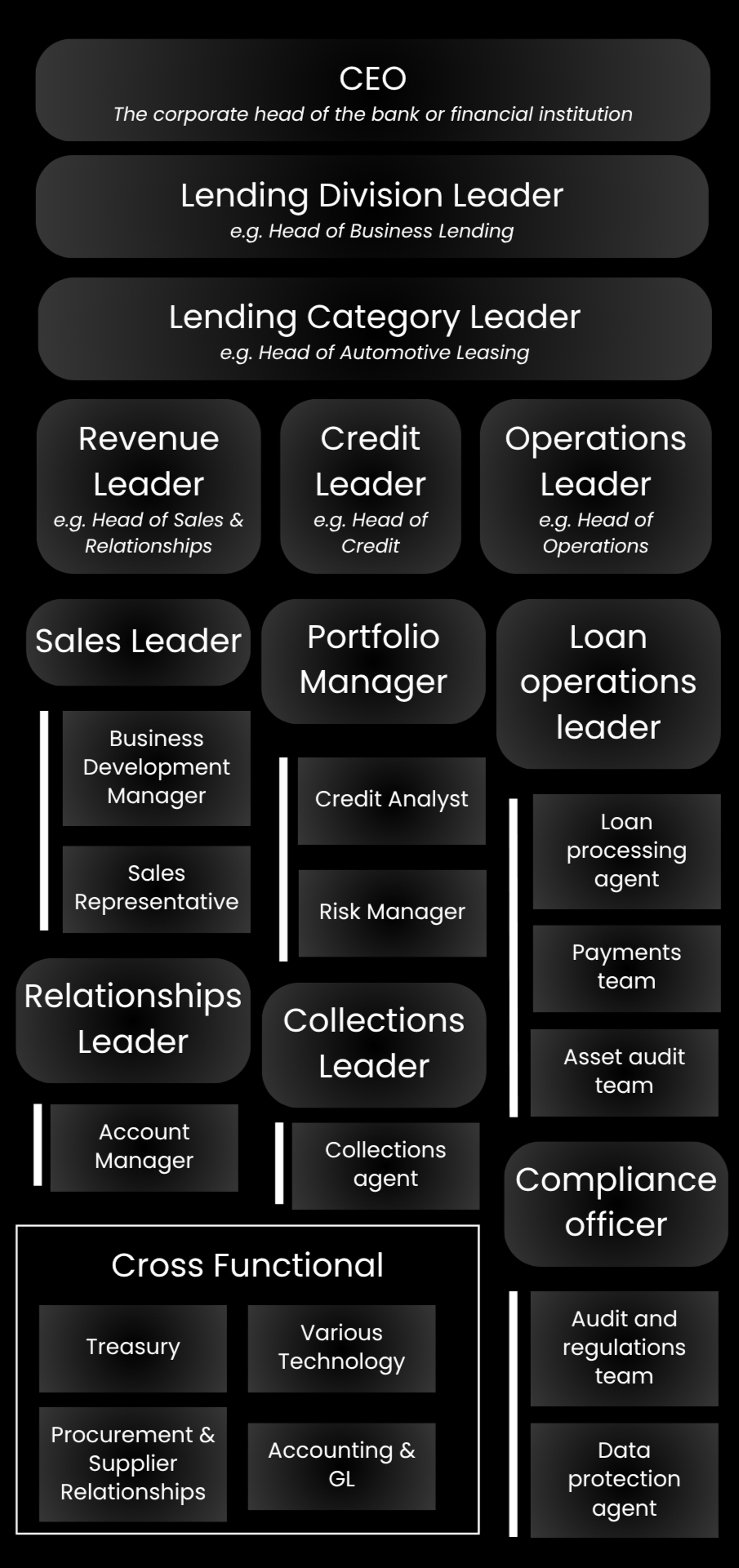
The typical structure of most lenders, using automotive lending as an example.
The reasons for this structural similarity remain speculative— secrecy in the lending industry makes definitive proof elusive. Yet, three core arguments consistently emerge.
First, all lending firms operate under similar pressures and constraints, leading them to evolve strikingly similar internal structures- this is the parallel evolution theory. I have to admit that I find this argument only partly convincing.
In practice most firms aren’t forced into a specific model by sustained regulatory, competitive, or employee pressure. When pressure is applied to them, it tends to be short and sharp; it lacks the staying power to create real change. So while crises—a regulatory scandal or a labor dispute—can trigger some change, these moments rarely result in a fundamental overhaul of the org charts. For an excellent example, look at the 2024 UK dealer commission scandal: huge compensation was set aside, but fundamental changes to lender structure remain off the agenda.
This suggests that parallel evolution due to shared pressure is a partial truth, not the whole story. So what else could explain the similarities?
The second argument I hear often is cross-pollination. Senior executives and middle managers tend to move between lenders over the course of their career, and this distributes methods and expectations across firms, replicating familiar operating models. When a manager takes charge of a specialized unit, they are often given the freedom to rebuild a team mirroring their past successes. They will often seek to recreate the conditions that yielded previous wins. I’ve witnessed this dynamic repeatedly myself, and I'd say there is some truth to this.
Finally, the third argument I hear is mutual recognition. Executives seek career mobility, and so they want their roles to be understandable across the industry so that when it comes to making that next job application, the person hiring them will have no trouble recognising their experiences at their last firm as being relevant to their new employer.
The easiest way to achieve this is to align job titles and responsibilities with the market average. This tendency gently pressures every lending organisation into the most common model, creating the structural uniformity we see today. My experience leads me to believe this to be the strongest effect of the three and also the most widespread. After all, job security and career ambitions can be terrific motivators.
So where does that leave us? If we accept that lenders structure themselves to match the industry average rather than optimizing for their unique competitive edge, the conclusion is clear: there must be significant scope for structural improvement. That's because if most lenders are busy copying each other's internal structures, then they are not optimizing for their particular and unique business challenges. How can there not be scope for improvement?